
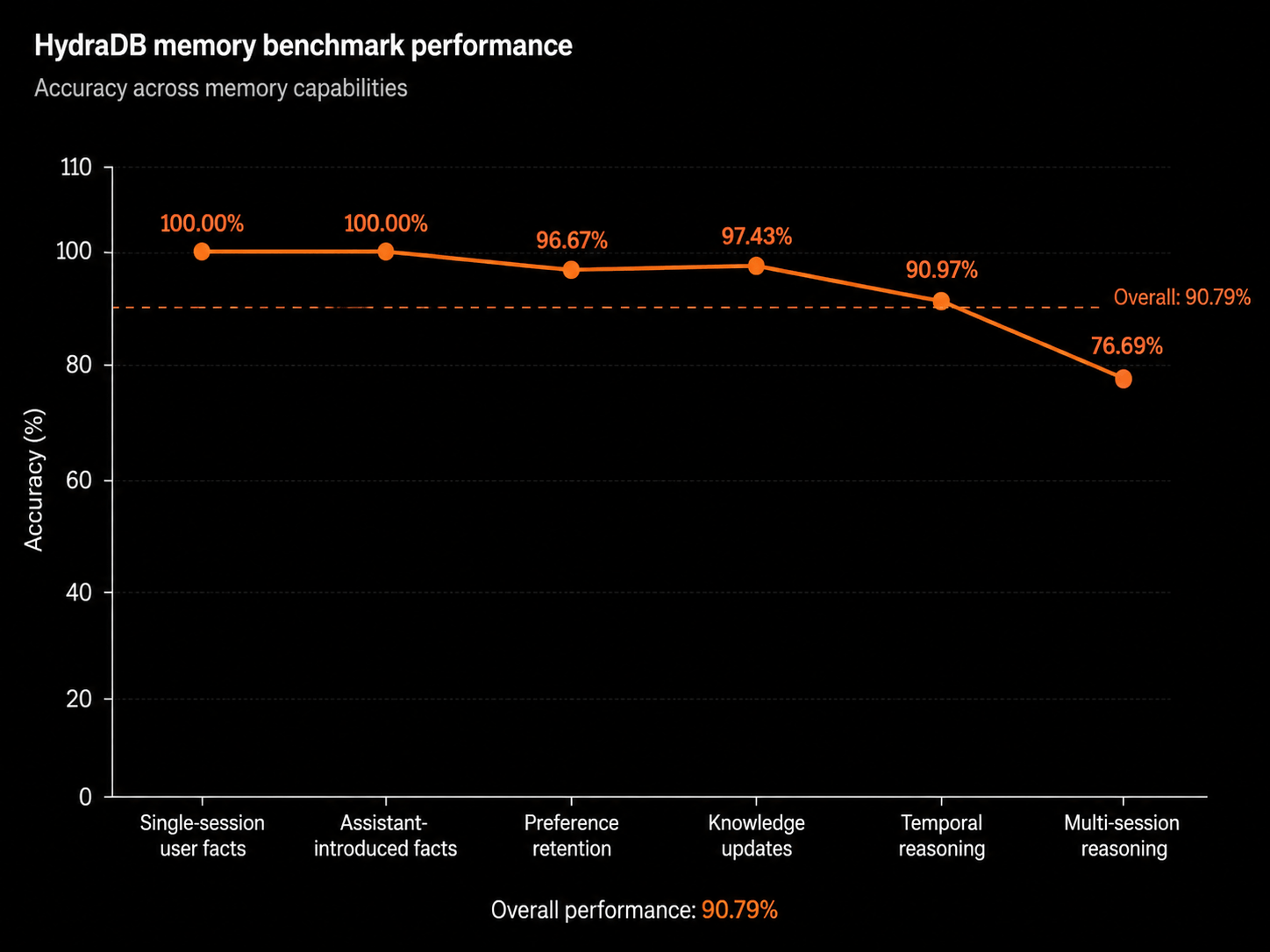
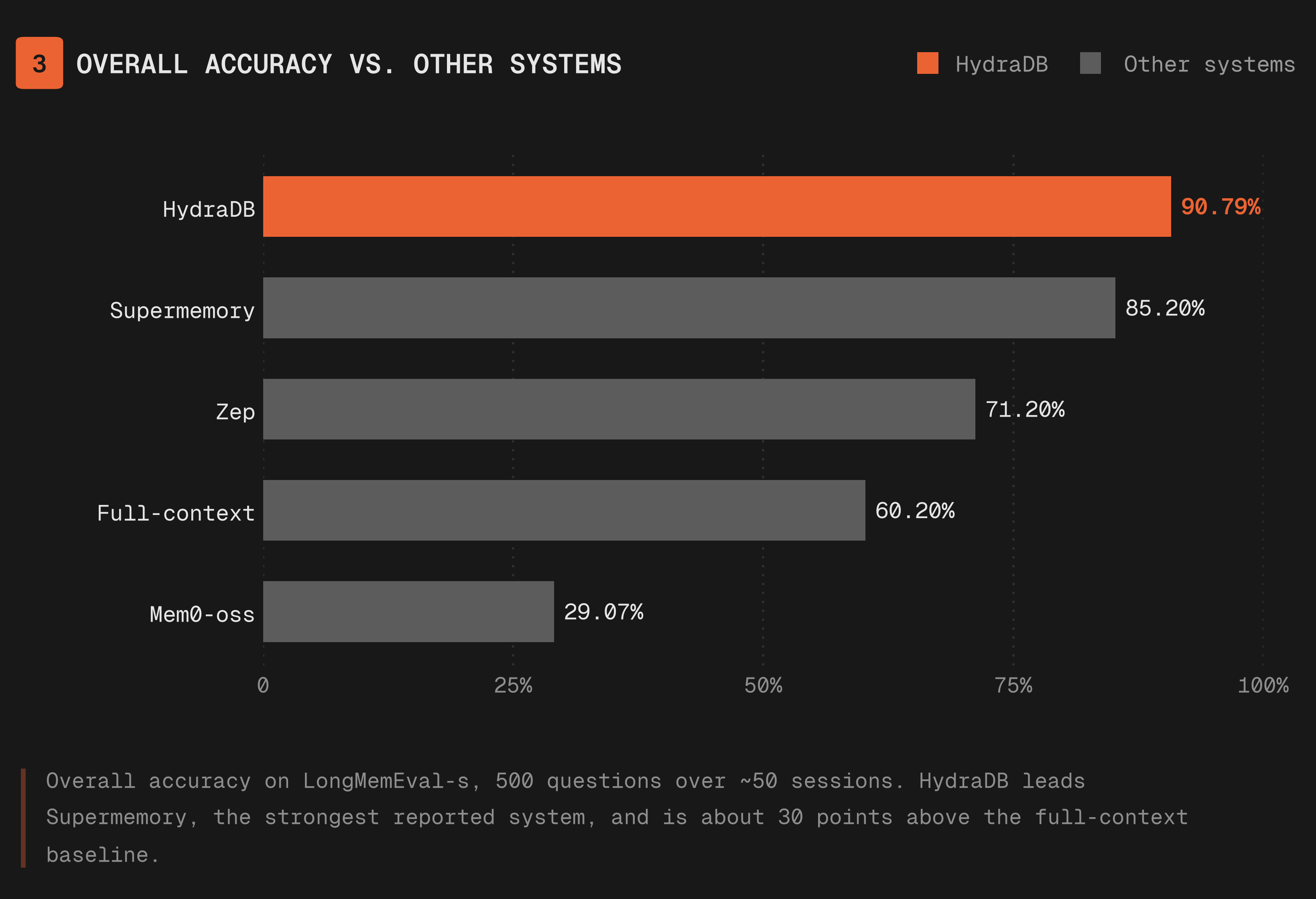
Assistants and agents that work with the same people for weeks accumulate long histories in which facts are stated once, preferences are expressed indirectly, and earlier information is later replaced. We evaluate HydraDB on LongMemEval-s, a long-term memory benchmark of 500 answerable questions over conversations averaging more than 115,000 tokens and roughly 50 sessions. HydraDB achieves 90.79% overall accuracy, 5.0 percentage points above the strongest reported competing system and about 30 points above the full-context baseline. It reaches 97.43% on knowledge updates, 90.97% on temporal reasoning and 96.67% on preferences, and with GPT-5 Mini as the answer model it reaches 85.80%, above the strongest competing system's flagship-model score of 85.20%.
Introduction
Giving a model the whole conversation history does not give it a usable memory. The answer to a question may sit in one sentence from forty sessions ago, a preference may have been implied rather than stated, and the fact that was true last month may have been replaced since. An agent has to find the right evidence, attach it to the right person, project or account, and know which version is current.
LongMemEval measures exactly this. HydraDB treats it as a context problem rather than a context-length problem: each session is enriched with its surrounding context, facts are linked to entities in a versioned knowledge graph, and retrieval returns a small set of connected, current evidence instead of the full history. The architecture is described in Beyond Flat Embeddings for Production AI Agents.
Evaluation setup
LongMemEval-s contains 500 answerable questions across conversations averaging more than 115,000 tokens and roughly 50 sessions. It tests whether an agent can recover facts, preserve preferences, combine evidence across sessions, reason over time, and select current information after updates.
Data is ingested session by session, to approximate an agent receiving information continuously rather than processing the complete history at once. Gemini 3.0 Pro is used as the primary answer model and evaluator. GPT-5.2 and GPT-5 Mini test whether the memory architecture generalizes across different model capacities.
Results
HydraDB achieves 90.79% overall accuracy, outperforming the strongest reported competing system by 5.0 percentage points and the full-context baseline by approximately 30 points.
Reliable factual recall
Perfect performance on user and assistant fact extraction shows that the system can recover explicit information even when it is surrounded by large amounts of unrelated history.
This is important for agents that must remember:
- Decisions made during meetings.
- Customer requirements from support conversations.
- Tasks assigned by an assistant.
- Project owners and deadlines.
- Constraints introduced during previous workflow steps.
The result indicates that relevant evidence remains retrievable without repeatedly placing the complete conversation history inside the model context.
Persistent personalization
HydraDB reaches 96.67% on preference questions, compared with 70.00% for the strongest baseline in this category. Preference memory is essential for customer-service agents, sales copilots, employee assistants and personalized applications. These systems must distinguish persistent preferences from temporary requests and recover them even when they were expressed indirectly or several sessions earlier.
For instance, an agent may need to remember that a customer prefers annual billing, that an engineer avoids deploying on Fridays, or that a user wants technical explanations without excessive abstraction.
Sliding-window enrichment makes these preferences explicit, while entity linking attaches them to the correct user, account or project.
Current-state reasoning
HydraDB achieves 97.43% on knowledge updates and 90.97% on temporal reasoning.
These categories directly measure whether an agent can distinguish current state from historical state, the kind of question that hinges on what is true now: who owns the migration now, which policy is currently active, whether the incident was resolved before the deployment, or what changed after the customer escalation.
The versioned graph preserves historical facts but allows retrieval to prioritize the latest valid state. This prevents an agent from treating an obsolete owner, policy, status or instruction as current merely because it is semantically similar to the query.
Cross-session reasoning
Multi-session reasoning remains the hardest category. HydraDB scores 76.69%, matching the strongest competing result but leaving a meaningful gap relative to simpler memory tasks.
These questions require the system to combine evidence distributed across different sessions rather than retrieve one explicit statement. For instance:
Project → blockedBy → Issue → assignedTo → Engineer → unavailableBecauseOf → Leave
Answering correctly may require retrieving multiple records, resolving entities, selecting temporally valid edges and composing the resulting path. The result suggests that graph-based retrieval substantially improves long-horizon reasoning, but multi-session evidence composition remains the primary area for further improvement.
Cross-model generalization
A useful memory system should improve weaker models rather than depend entirely on a large reasoning model.
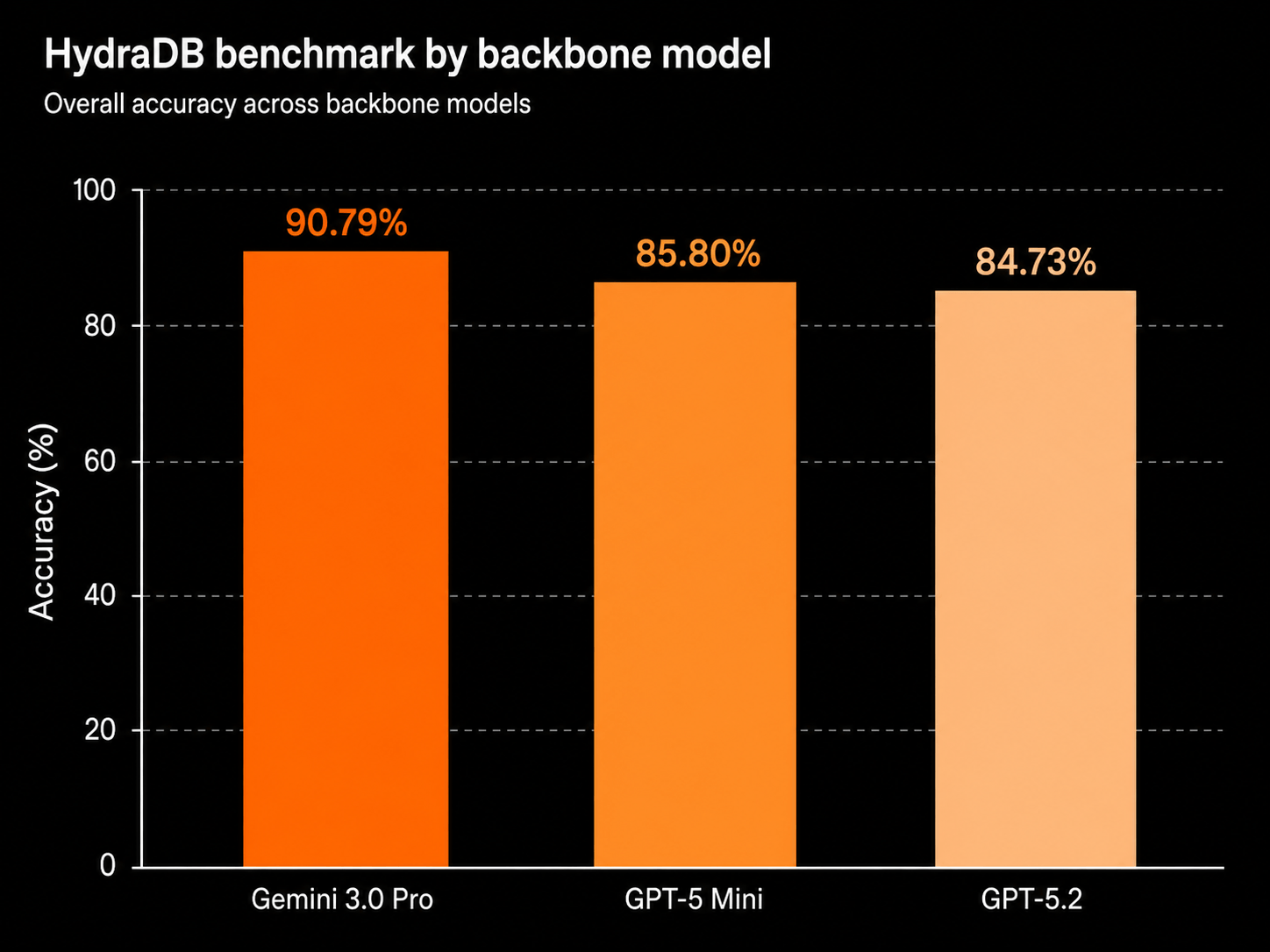
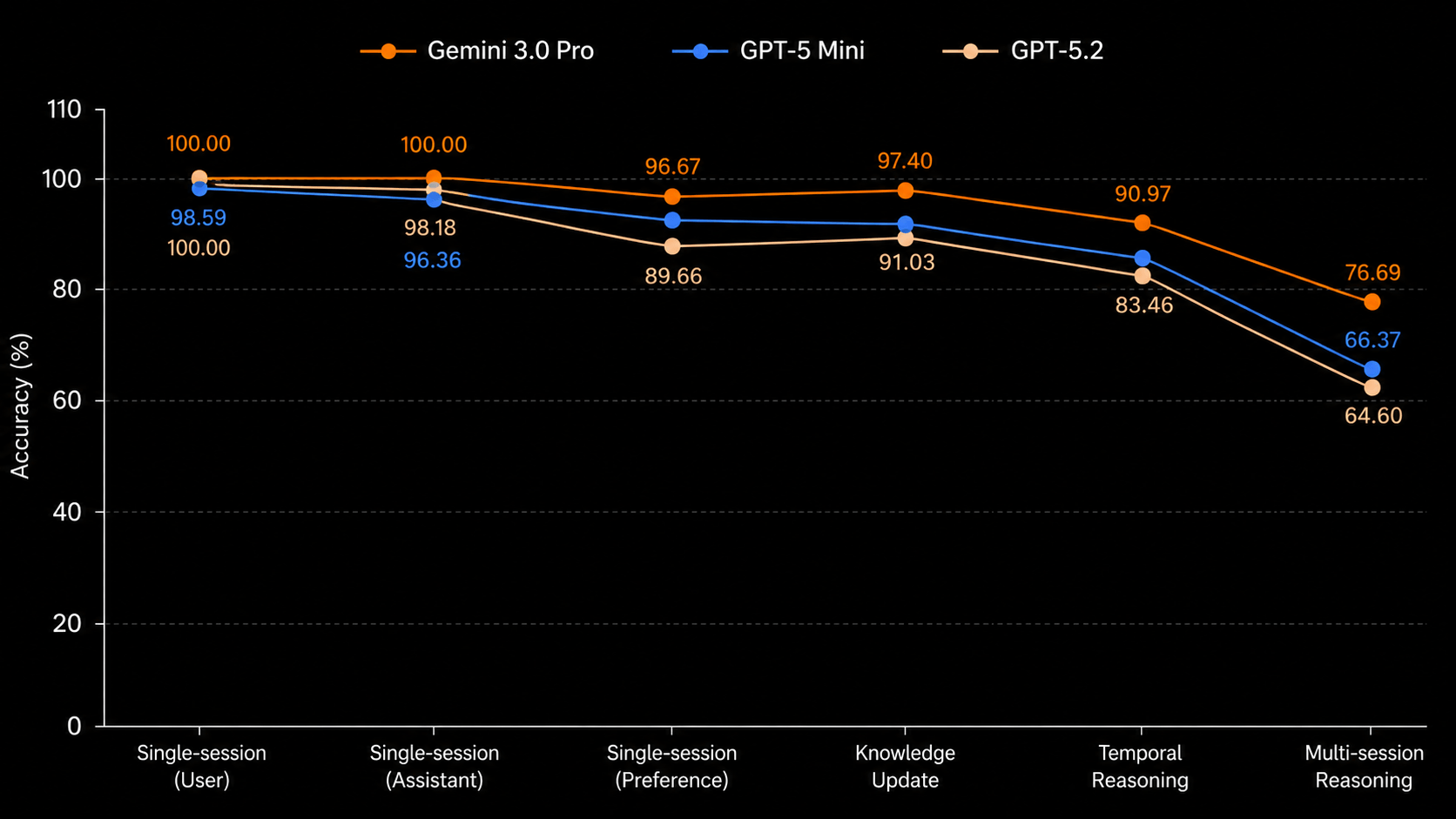
HydraDB remains within approximately six percentage points across all three models. GPT-5 Mini reaches 85.80%, above the strongest competing system's flagship-model score of 85.20%.
This indicates that retrieval quality, temporal indexing and context construction can partially compensate for lower model capacity. A smaller model receives a compact set of connected, current and relevant evidence instead of reasoning over a large, noisy history.
Why this matters for AI agents
The results show that HydraDB is strongest where long-running agents commonly fail: preserving preferences, tracking updates, reasoning over chronology and retrieving facts across long histories. This suits agents that operate continuously over changing data:
- Support agents that remember customer history and unresolved issues.
- Project agents that track owners, blockers, decisions and deadlines.
- Sales agents that preserve account preferences and relationship history.
- Compliance agents that retrieve the currently valid policy with provenance.
- Incident agents that reconstruct failures, dependencies and remediation timelines.
- Employee assistants that connect conversations, documents, tickets and organizational entities.
Conclusion
On LongMemEval-s, HydraDB reaches 90.79% overall accuracy, including 97.43% on knowledge updates, 90.97% on temporal reasoning and 96.67% on preferences, and holds 85.80% with GPT-5 Mini. Long conversational histories need more than a large context window: they need memory that knows which fact is current, whom it belongs to, and how it connects to the rest. Cross-session composition remains the main gap. LongMemEval is one of eight public benchmarks in HydraDB's consolidated evaluation, Beyond Flat Embeddings for Production AI Agents.
References
- LongMemEval: Benchmarking Chat Assistants on Long-Term Interactive Memory. Wu, D. et al. (2025). arXiv:2410.10813
- Supermemory: State-of-the-Art Agent Memory on LongMemEval. Daga, S., Sreedhar, S., Shah, D. (2026). supermemory.ai/research
- Zep: A Temporal Knowledge Graph Architecture for Agent Memory. Rasmussen, P. et al. (2025). arXiv:2501.13956
- Mem0: Building Production-Ready AI Agents with Scalable Long-Term Memory. Chhikara, P. et al. (2025). arXiv:2504.19413
- Lies, Damn Lies, & Statistics: Is Mem0 Really SOTA in Agent Memory? Chalef, D., Rasmussen, P. (2025). blog.getzep.com
- Beyond Flat Embeddings for Production AI Agents. HydraDB Research Team (2026). benchmarks.hydradb.com/hydradb