
Introduction
Giving an AI model a one-million-token context window does not give it one million tokens of useful memory. It is like giving you an entire 500-page book to find a small answer: you will waste a lot of time reading things you aren’t looking for, and you will get confused by unstructured facts that appear along the way. Real applications accumulate months of conversations, decisions, updates, documents, preferences, tasks, and events, where newer information can replace older information and the answer to one question may depend on something that happened hundreds of thousands of tokens ago. The problem is no longer simply “Can the model read all of this?” It becomes “Can the application remember what matters, know what is still true, connect information across sessions, and retrieve the right state when it is needed?” This is the problem HydraDB is designed to solve, by turning memory into persistent, structured, time-aware memory that applications can retrieve from.
BEAM 1M tests this problem at the million-token scale. BEAM is a long-term memory benchmark with four context tiers: 128K, 500K, 1M, and 10M tokens, and it measures ten different memory abilities, including temporal reasoning, event ordering, knowledge updates, contradiction resolution, information extraction, preference following, and reasoning across sessions. HydraDB was evaluated on the 1M-token tier and achieved an 82% overall score compared with Hindsight's published 74%, using the same answer-generation and evaluation configuration as Hindsight's benchmark setup.
The important result is not only the eight-point overall improvement. The largest differences appear exactly where long-running applications usually become difficult. HydraDB scores 91% in Temporal Reasoning compared with 60% for Hindsight, 80% vs 61% in Information Extraction, 60% vs 46% in Multi-Session Reasoning, and 92% vs 81% in Event Ordering. These are not simply question-answering abilities. They measure whether a memory system can understand what happened, when it happened, how distant pieces of information relate, and whether the application can recover the right information after a very long history.
| Memory dimension | Hindsight | Hydra DB | Δ |
|---|---|---|---|
| Temporal Reasoning | 60 | 91 | +31 |
| Information Extraction | 61 | 80 | +19 |
| Multi-Session Reasoning | 46 | 60 | +14 |
| Event Ordering | 81 | 92 | +11 |
| Contradiction Resolution | 59 | 66 | +7 |
| Summarization | 84 | 88 | +4 |
| Abstention | 90 | 89 | −1 |
| Instruction Following | 93 | 92 | −1 |
| Preference Following | 97 | 96 | −1 |
| Knowledge Update | 66 | 63 | −3 |
| Overall average | 74 | 82 | +8 |
Large Context Is Not Long-Term Memory
Imagine a financial research agent that has worked with an analyst for six months. In January, management expects margins to improve. In March, logistics costs rise and guidance changes. In May, the company launches a cost-cutting program. In July, margins recover. During those months the agent also reads filings, earnings transcripts, research notes, and conversations with the analyst. A million-token model may technically be able to fit a large portion of that history into its context window, but the application still has to determine which statements are current, which statements are historical, which events caused later events, and which few pieces of evidence are relevant to the current question.
To solve this, it requires the application to reconstruct state over time. January's expectation should not disappear because March introduced new information, but it also should not be treated as the current expectation. May's cost-cutting program needs to remain connected to the problem it was intended to address, while July's improvement needs to be interpreted using the earlier events.
Applications Need State, Not an Infinite Chat History
A normal context layer often treats memory as a collection of messages or chunks:
Message1, Message2, Message3, Document1, Message4, Document2, Message5
When the application asks a question, the system searches this history and returns similar pieces of text. This works until facts begin to change. Suppose an application stores:
Q1: Logistics costs expected to decline.
Q2: Logistics costs increased sharply.
Q3: Logistics costs declined after restructuring.
All three statements are valid pieces of historical information. But only one describes Q3. This is why HydraDB models knowledge as a versioned, relational, time-aware graph rather than only a flat collection of text fragments. Updates can be represented as new state instead of destroying the old state, allowing the application to reconstruct what was known at different points in time.
Why HydraDB Performs Better on Temporal Memory
HydraDB's largest BEAM advantage appears in Temporal Reasoning: 91% compared with 60%, a 31-point difference. Event Ordering also improves from 81% to 92%. The architecture helps explain why.
For instance:
Log1: Company expects margin expansion.
Log2: Company no longer expects margin expansion.
the memory layer can preserve both pieces of information together with their timestamps and relationships.
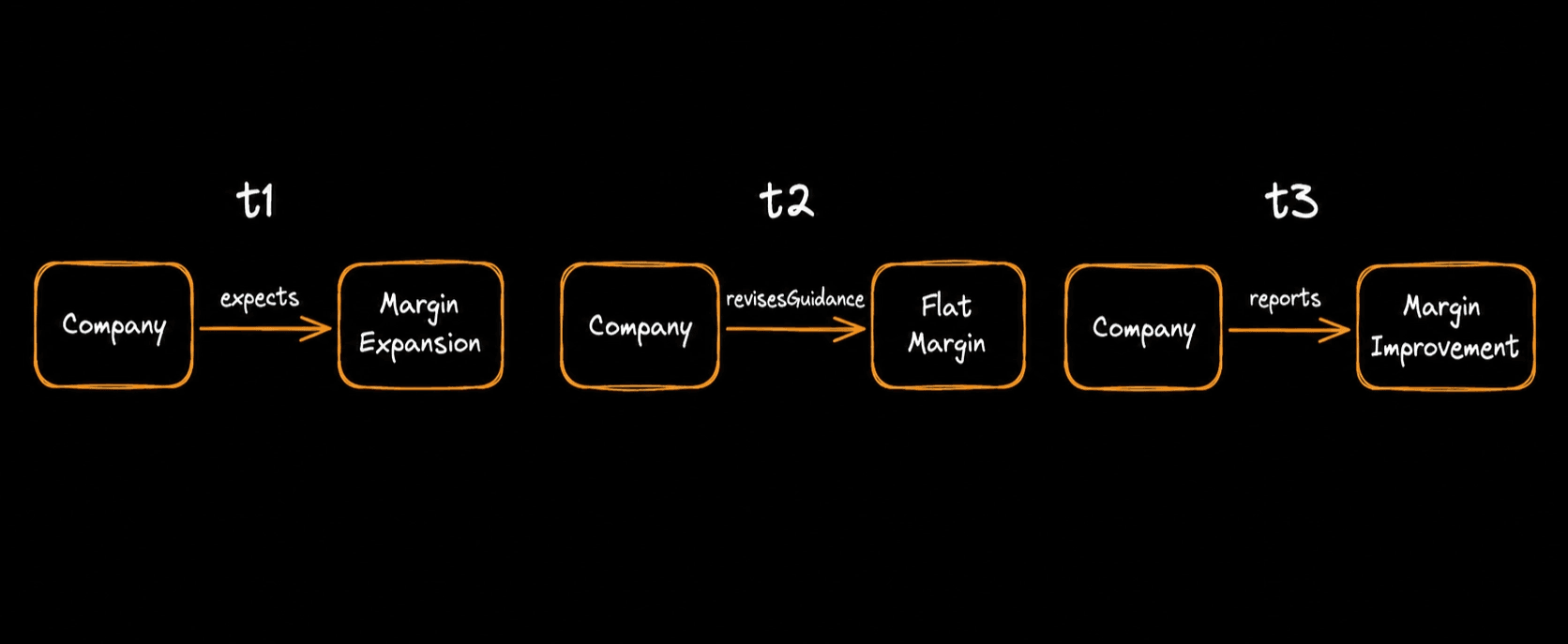
The old fact remains useful because an application may later ask “What did management expect before guidance changed?” or “What is management's current guidance?”. The memory layer can prioritize the latest valid state.
This distinction sounds simple, but it is fundamental to applications that live for months or years. A customer agent, financial analyst, coding agent, personal assistant, or enterprise copilot will constantly encounter facts that were once correct and later changed.
Deleting old information destroys history. Keeping everything without state creates contradictions. HydraDB’s solution is versioned memory.
Memory Also Has to Work Across Sessions
Real applications do not operate inside one continuous conversation. An analyst may discuss a company on Monday, return two weeks later, upload a new filing, and ask a follow-up question a month after that. A coding agent may start an implementation in one session, encounter a bug in another, and finish the migration weeks later. The application should experience these as one continuous knowledge state even though the interactions happened across different sessions.
BEAM measures this directly through Multi-Session Reasoning. HydraDB scores 60% compared with Hindsight's 46%, a 14-point advantage. The difference comes from treating new information as part of an evolving memory graph rather than leaving each conversation as an isolated block.
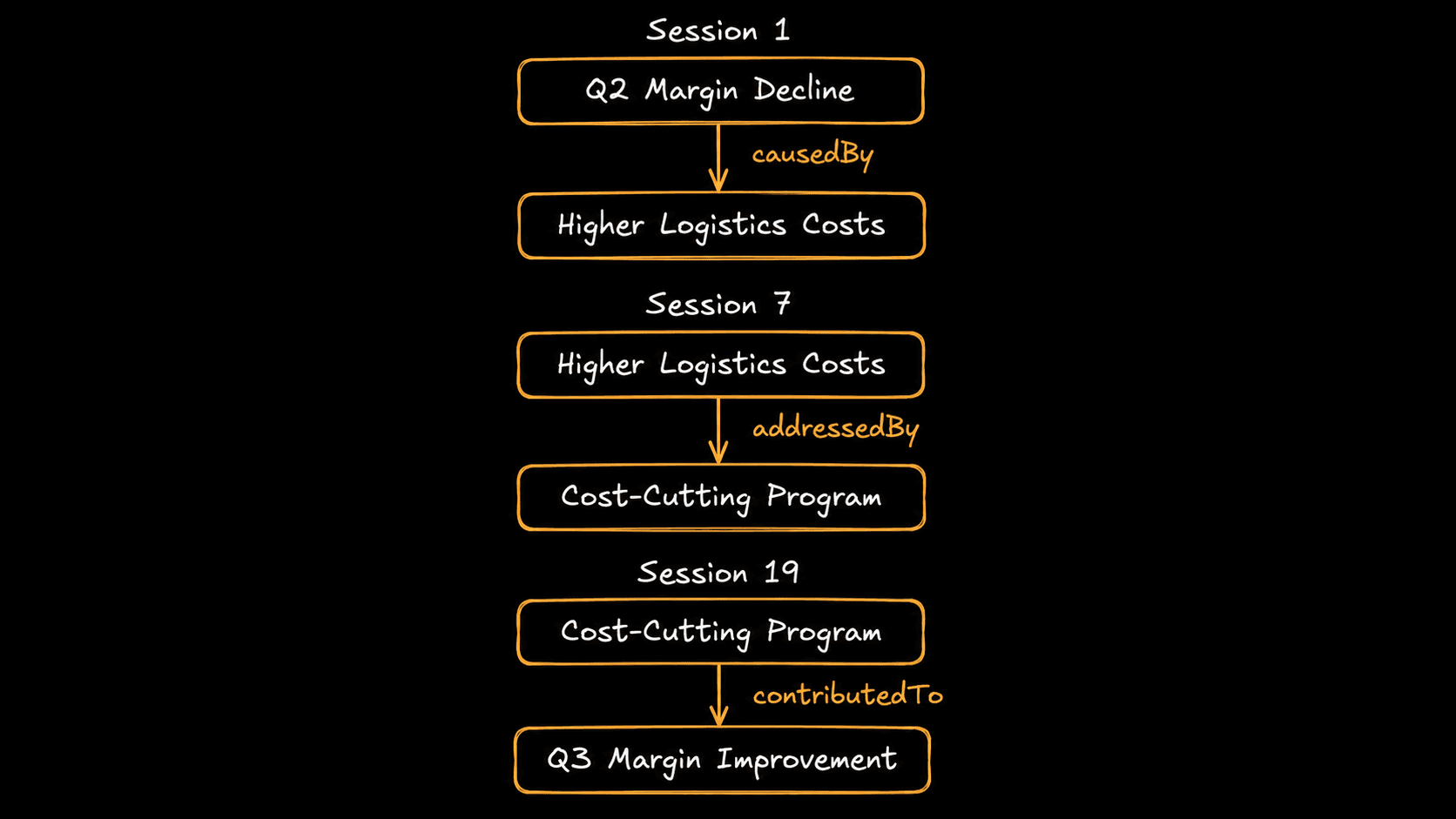
A question in Session 20 might be: “Why did margins recover?” Answering it requires information introduced across three separate sessions.
The application should not care where the facts originally appeared. HydraDB's job is to preserve their relationships and retrieve the smallest connected set of evidence required to answer the question.
Retrieval Becomes Harder as Memory Grows
At one million tokens, another problem appears: even if the information exists somewhere in memory, the system still has to find it. HydraDB scores 80% in Information Extraction compared with Hindsight's 61%, a 19-point improvement.
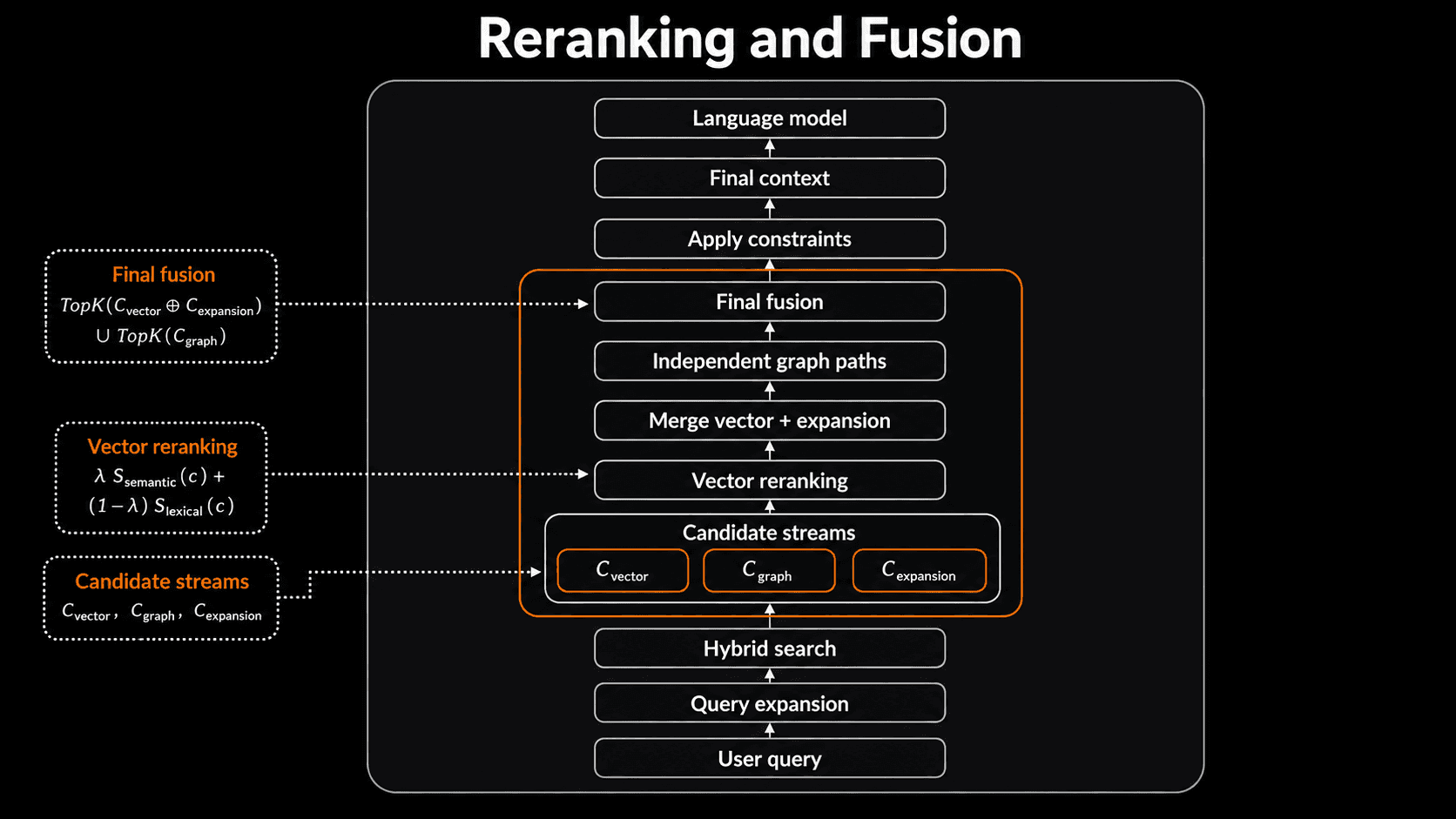
HydraDB does not rely on one retrieval method. Its architecture first uses sliding-window inference to turn ambiguous messages into more self-contained information, then combines dense semantic retrieval, sparse retrieval, graph relationships, query expansion, and reranking. This matters because application memory contains very different kinds of information.
The Application Should Not Manage Memory Itself
Without a dedicated memory layer, every AI application eventually starts rebuilding the same system, At that point, memory logic has become part of application code. HydraDB moves this complexity underneath the application.
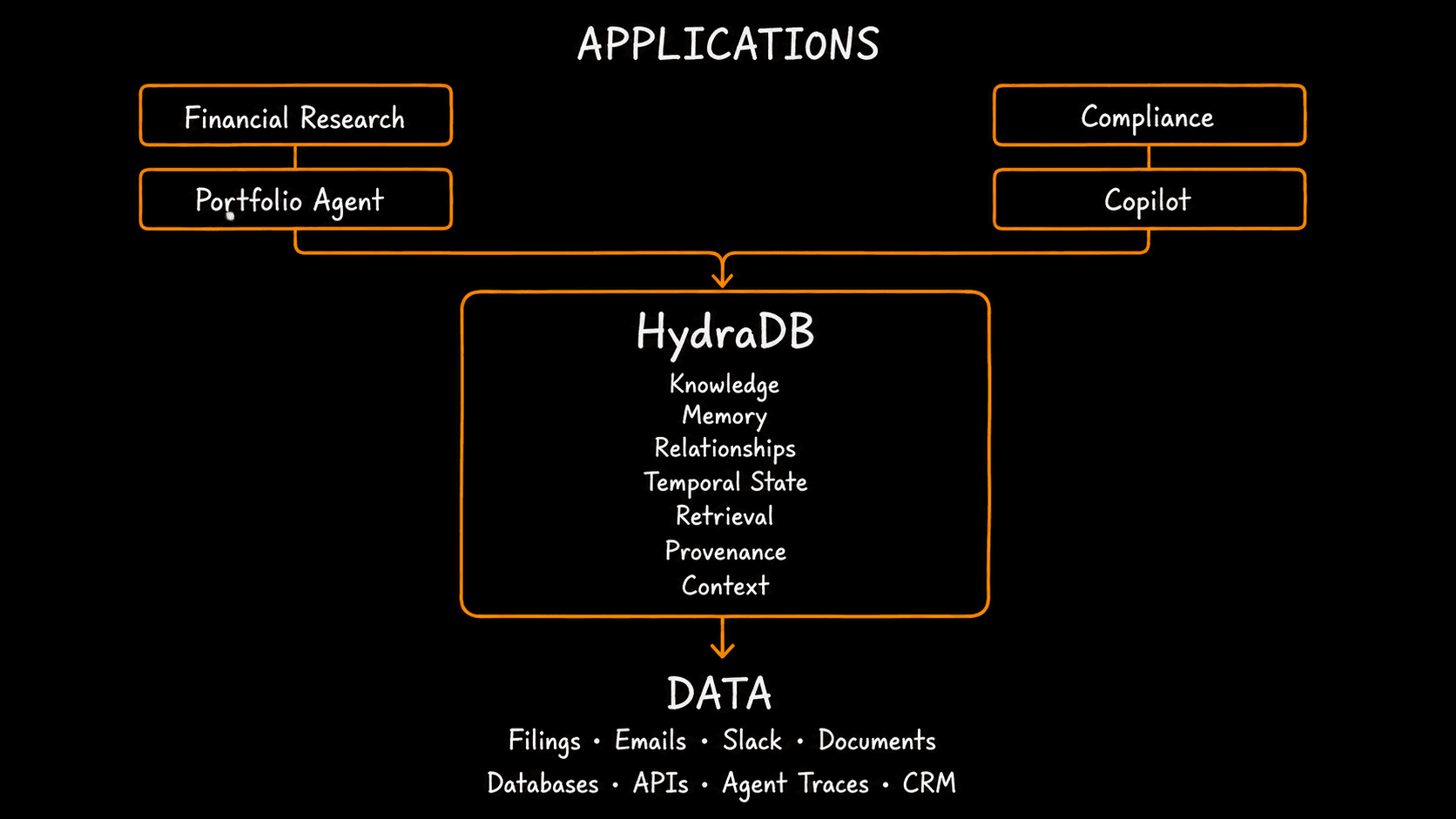
The application focuses on its workflow. HydraDB maintains what the application knows. HydraDB provides not just a context layer, but an ontology-based knowledge graph database, so developers and enterprises can plug it into their AI agents and be good to go. This is the same architectural separation that databases brought to traditional software: applications should not have to implement their own persistence engine, and AI applications should not have to implement their own long-term memory engine.
Conclusion
HydraDB scores 82% overall on BEAM 1M, outperforming Hindsight by 8 points, but the more important result is where those gains come from. HydraDB performs strongest on temporal reasoning, multi-session reasoning, event ordering, and information extraction, the exact problems that become difficult when an AI application has months of changing, connected history. HydraDB turns that history into persistent, application-ready state, making it a memory substrate for AI applications rather than simply another long-context retrieval system.
References
- BEAM: Benchmark for Evaluation of AI Memory. Tavakoli, M. et al. (2025). arXiv:2510.27246
- BEAM Dataset Repository. Tavakoli, M. et al. — GitHub (2025). github.com/mohammadtavakoli78/BEAM
- Hydra DB: A Context Engine for Long-Term AI Memory. Technical White Paper (2026). Read the HydraDB research paper
- Hindsight: Long-Term Memory for AI Systems. (2026). arXiv:2512.12818. agentmemorybenchmark.ai